


by Cameron Ward
Independent artists and designers building careers outside traditional gatekeepers often run into the same frustrating gap: strong work exists, but creatives’ visibility challenges keep it from reaching the people who would pay for it. Exposure obstacles for creatives rarely look like a lack of talent; they show up as inconsistent demand, unclear market signals, and pressure to chase trends that drain creative autonomy. That mismatch makes monetizing creative passions feel unpredictable, even for highly skilled creators. Closing it is the difference between sporadic wins and real artistic career sustainability.

What Helps Creatives Get Noticed
- Focus on audience engagement to build visibility and trust around your creative work.
- Polish and optimize your online portfolio so your best work is easy to find and evaluate.
- Strengthen artist branding fundamentals to present a clear, professional identity across platforms.
- Apply creative business essentials to make decisions that support sustainable growth.
- Use simple monetization strategies to turn passion into reliable profit.
Understanding Positioning and Profit Basics
Getting noticed and getting paid starts with clarity: who you serve, what you’re known for, and why someone should pick you over alternatives. Then you pressure-test the offer with numbers, using profit margins to see what’s left after costs, not just what sells.
This matters because great work can still lose money if pricing ignores time, tools, revisions, and delivery, and because business fundamentals are transferable across roles, whether you’re freelancing or coming from various business degrees. Benchmark thinking like average net profit margin helps you set targets and protect creative energy.
Picture a motion designer who targets indie app teams, positions as “launch-week speed,” and differentiates with modular templates. A simple margin check reveals whether a “flat fee” covers software, subcontracting, and extra rounds, or needs tiers.
Clarity to Publish to Connect to Track to Refine
This workflow turns your message and pricing into repeatable visibility, so attention can become revenue without constant reinvention. It works for music, art, tech, and design because it balances making, distribution, and relationship-building while keeping business inputs measurable. Treat it like an operating system: small actions, consistent cadence, clear signals.
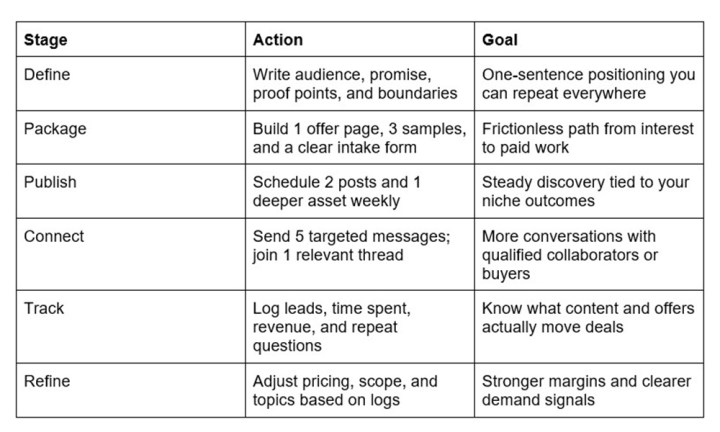
Define keeps your story consistent, Package makes it purchasable, and Publish creates predictable touchpoints. Connect converts reach into relationships, while Track and Refine protect your time and improve decisions over time.
Tactics to Put Your Work in Front of Buyers
Visibility works best when treated like a repeatable business system: publish consistently, connect intentionally, track what moves the needle, and refine without burning out. Use the tactics below to get in front of buyers while protecting creation time.
- Create a “discovery loop” on social media (one hook, three cuts, one link): Pick one finished piece each week and produce three short variations (process clip, final reveal, and a “why I made this” story) that all point to the same landing page. If you’re using Instagram, build around Reels because the reels drive time spent and discovery favors short, watchable formats. Track saves, shares, and profile clicks so you can refine your hook, not just chase likes.
- Run 15-minute “connection sprints” instead of endless scrolling: Set a timer 3x per week: leave 5 thoughtful comments on posts from curators, producers, studio owners, or collectors; send two DMs with a specific compliment and a clear ask; add one person to your CRM/spreadsheet. This supports the Connect stage without turning promotion into a full-time job. Use a simple template: “Loved X, my work explores Y, would you be open to a quick intro/feature/collab?”
- Build one collaboration that has a buyer path: Choose partners whose audiences overlap with your buyers, e.g., a sound designer + visual artist for an audiovisual pack, or an industrial designer + 3D artist for a concept kit. Agree on deliverables, deadlines, and revenue split in writing, then publish a shared launch plan (two posts each + one live session). Collaborations borrow trust, multiply reach, and create bundled offers that are easier to price.
- Start a simple email list with a “two-track” cadence: Offer a one-page freebie tied to your work (sample pack teaser, wallpaper, mini print, behind-the-scenes PDF) and collect emails on your site. Send two types of emails: a monthly “studio letter” (story + 1 new piece) and a launch email only when something is for sale. Track opens and link clicks to refine your subject lines and offers over time.
- Use exhibitions and online galleries as lead generators, not vanity plays: Apply to one local show or juried digital exhibition per month, but only if you can capture leads. Add a QR code that links to a “featured work” page with a clear next step: buy, inquire for commissions, or join your email list. After the show, follow up within 72 hours with a short note and one relevant piece, not your entire portfolio.
- Make your portfolio mobile-first and conversion-ready: Buyers often find you on their phone first, and over 60% of web traffic comes from mobile devices. Check your site on mobile today: load speed, readable text, obvious pricing or inquiry button, and a single featured project above the fold. Add a “Start here” page that mirrors your Clarity stage: who you help, what you make, and what to do next.
- Install promotion guardrails so marketing doesn’t eat your craft: Time-block 2 to 4 hours per week for visibility and batch it (one creation session, one scheduling session, one connection sprint). Keep a simple dashboard: posts shipped, emails sent, leads captured, and revenue per offer. That Track-to- Refine loop turns promotion into feedback, so you can choose one move to repeat for the next seven days with confidence.
Turn Visibility Into Income With One Weekly Creative Commitment
Making strong work while staying visible can feel like a split job, and creative blocks can make promotion feel pointless. The answer is an entrepreneurial mindset for artists: treat attention as a system, pace your output, and pair long-term career planning with community building among creatives so the work has somewhere to land. Done consistently, the payoff is sustainable creative success, clearer demand, steadier cash flow, and less anxiety about where the next opportunity comes from.
Consistency beats intensity when turning creative passion into profit. Choose one visibility action for the next seven days and schedule it like a client commitment. That rhythm builds resilience, connection, and financial stability that supports better work for the long haul.
About the Author
Cameron Ward is an entrepreneur, MBA student, and math afficionado. She provides budgeting and funding information that helps business owners streamline their financial management through easy-to-implement processes and platforms so that they can stick to the business of running their business.
 Mat Dirjish Online