


by Shirley Martin
Creative professionals who juggle client deadlines, personal experiments, and fast-changing tech often find the hardest part isn’t the work, it’s the business management challenges around pricing, paperwork, and time. When those basics stay fuzzy, creative entrepreneurship starts to feel like a constant tradeoff between doing great work and keeping the lights on. Business skills for artists aren’t a vibe killer; they’re the structure that protects attention, energy, and momentum. A clearer creative career balance makes it easier to say yes to the right projects and keep the spark consistent.
Key Takeaways for Creative Business Basics
- Set clear pricing strategies that reflect your value and protect your creative energy.
- Use simple contracts to define scope, rights, timelines, and payment expectations.
- Build workflow basics that streamline projects and reduce friction from start to delivery.
- Organize finances with simple systems for tracking income, expenses, and planning ahead.
- Practice authentic marketing and time management strategies to stay visible without losing your spark.
Set Prices, Paperwork, and a Simple Business Flow – A Practical Way to Set It All Up.
This process helps you turn your creative output into a repeatable, paid offering with clear terms, clean invoicing, and a lightweight workflow you can run between studio time and experimentation. It matters for modern music, art, photonics, and AI work because projects often mix R and D, iteration, and client feedback, so clarity protects both your time and your creative spark.
- Step 1: Price one core service with clear boundaries Start with one flagship offer (for example: an AI-assisted sound design pack, generative visuals for a performance, or a photonics installation consult) and define exactly what’s included, what counts as extra, and your turnaround time. Choose a pricing style you can explain in one sentence (flat project fee, day rate, or usage-based add-ons) so clients can say yes without a long back-and-forth. If your work scales with outputs or compute, note that 85% of surveyed companies have adopted UBP, which can inspire a simple “base + usage” structure for creative tech services.
- Step 2: Adapt a contract template to match how you create Pick a basic template and customize only the essentials: scope, timeline, payment schedule, revision limits, usage rights, and cancellation terms. Add one plain-language clause that describes your process (drafts, test renders, listening sessions, prototype reviews). Keep it readable so you will actually send it every time.
- Step 3: Build an invoice that gets you paid faster Create one invoice layout and reuse it: your legal name or studio name, client details, a short description of deliverables, due date, and payment methods. Treat the invoice as a mini-summary of the agreement so there’s no confusion about what the client is paying for. If you collaborate with vendors, remember that vendors and suppliers can share invoices in multiple formats, so standardizing your own format reduces re-entry and errors.
- Step 4: Sketch a simple workflow you can repeat Map your work into five boxes: inquiry, scope and quote, contract and deposit, creation and review, final delivery and invoice. Put one “decision gate” in the middle where you confirm scope before adding new features or extra rounds. This keeps open-ended creative exploration from quietly turning into endless revisions.
- Step 5: Formalize only when it reduces friction Choose a trigger for stepping up from informal to formal: consistent monthly revenue, higher-risk client work, hiring collaborators, or licensing and IP-heavy projects. When that trigger hits, compare your options and consider guided LLC formation plus ongoing compliance support if it will remove admin tasks you tend to avoid, and ZenBusiness can be part of that comparison. The goal is not complexity; it is less drag so you can ship more work.
Small Structures But More Freedom To Experiment
Plan-to-Track-to-Create-to-Deliver-to-Review
Your best work stays alive when the business layer is small, steady, and scheduled. This rhythm blends financial tracking, project timeline planning, deposit policies, and scope control so your studio hours remain protected while you ship work across music, art, photonics, and AI systems. Run it weekly, with a short monthly reset to prepare for taxes and any LLC setup basics admin milestones.
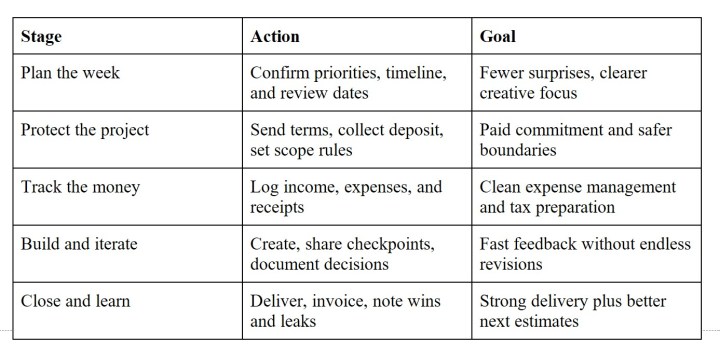
Planning makes the work legible, protection contains it, and tracking turns chaos into calm numbers. Iteration stays playful because defining review points and closing the loop improves pricing, timelines, and future scope control. Start small, repeat weekly, and let consistency carry the load.

Weekly Marketing Habits That Feel Like Creating – Small Ritual Maintain Visibility
When marketing becomes a repeatable practice, it stops feeling like performance and starts feeling like craft. These habits help artists, producers, graphics tinkerers, and AI builders stay discoverable without draining the energy you need to experiment.
One-Page Portfolio Pulse
- What it is: Spend 10 minutes updating a single portfolio page with one fresh proof.
- How often: Weekly.
- Why it helps: Regular updates compound credibility without triggering a big site rebuild.
Naming Convention Lock-In
- What it is: Apply consistent naming conventions to projects, files, and releases.
- How often: Per new project.
- Why it helps: Clear labeling makes your body of work easier to browse and share.
- Proof Capture Habit
- What it is: Save one testimonial line, metric, or process photo into a “proof” folder.
- How often: After each milestone.
- Why it helps: Social proof becomes effortless when you collect it while it happens.
Tiny Outreach Loop
- What it is: Send two personal notes offering a useful link, sample, or quick idea.
- How often: Weekly.
- Why it helps: Consistent contact builds relationships that lead to aligned opportunities.
Brand Check-in Questions
- What it is: Do a 5-minute review to start with a brand assessment and refine your message.
- How often: Monthly.
- Why it helps: You stay coherent across mediums while your style keeps evolving.
- Pick one habit this week, then tune it to fit your family’s rhythm.
Build A Simple Business System That Protects Your Creativity
The hard part is not creating; it is carrying the business side without letting it drain the work you actually love. The way through is small, steady structure: pick a few foundational business tools, run a monthly business routines review, and treat every tweak as system iteration guided by a growth mindset.
Over time, decisions get clearer, outreach feels lighter, and creative business confidence starts to compound. Build the business like a system, so your creativity stays the engine. Choose three foundations to focus on this month and put a recurring review on the calendar. That rhythm creates stability and resilience, so the work can keep growing without burning out.
About the Author
Shirley turned a neat freak personality into a business when she became a home organizer. When she isn’t busy working her skills on homes in need of a special touch, she is sharing helpful tips on her site, Tidy Life Today.
 Mat Dirjish Online