

by Mat Dirjish
Under the leadership of Assistant Professor Hyunseok Shim, a research team at Pusan National University, Korea has developed what they describe as a stretchable organic electrochemical transistor (OECT) that is easily reprogrammable for diverse applications. Highly suitable for use in wearable electronics in medical and healthcare applications, the transistor is soft in feel and operates by moving ions through a conducting polymer. It is reverse switchable from a logic circuit for digital computations to an analog artificial synapse by changing its surrounding salt concentration.
Rather than create a new material, the researchers modified the conducting Poly (3,4-ethylenedioxythiophene polystyrene sulfonate polymer (PEDOT: PSS) with two additives. These improved the electrical conductivity of the OECT and its ability to stretch without degradation. Importantly, changing the concentration of sodium chloride in the electrolyte altered how ions moved through the transistor, making it possible to switch between operational modes.
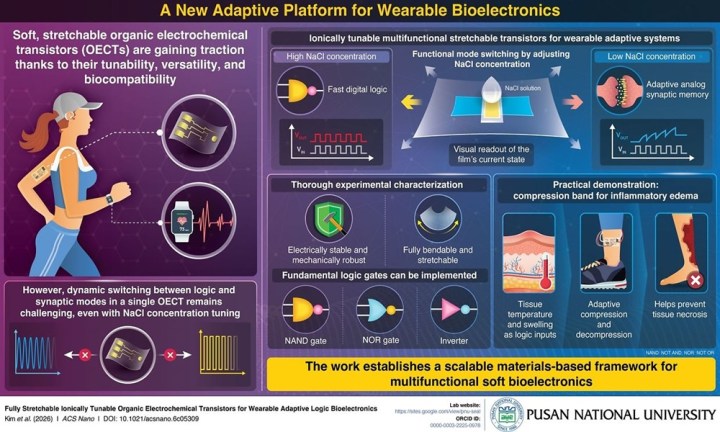
High salt concentrations enable rapid on/off gating, a necessary feature for digital logic operations. Conversely, lower salt concentrations produce an analog memory-like behavior, similar to the voltage profile of synapses between neurons.
Another important feature, the device’s internal state is visible. As it switches modes, it also changes color from light to dark blue, letting users read out its operational status visually. Dr. Shim explains, “The proposed platform is suitable for smart electronic skin, wearable health monitors, and soft bioelectronic implants, where a single stretchable device can both process and store physiological signals without added circuitry.” As a proof of concept, the team built a wearable patch that senses inflammatory edema and skin temperature, then automatically tightens or loosens a compression band, reducing the risk of tissue damage.
Dr. Shim adds, “In the longer term, this work could lead to autonomous personalized therapeutics, such as dynamic compression bandages and electronic skins that respond to injury in real time, all monitored at a glance through a visible color change.” By combining biological signaling with low-power computing performed directly within the sensor, the technology could contribute to future neuromorphic bioelectronics, soft robots, and adaptive prosthetic devices that learn from and respond to their surroundings.
For greater insights, read the Fully Stretchable Ionically Tunable Organic Electrochemical Transistors for Wearable Adaptive Logic Bioelectronics paper. For other research projects, visit the Pusan National University website.

