

by Mat Dirjish
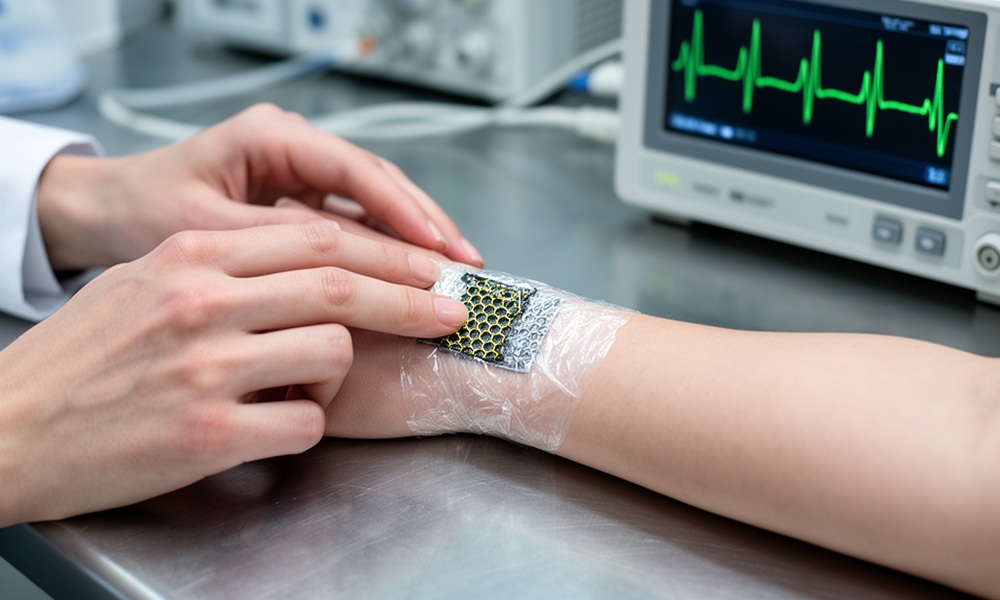
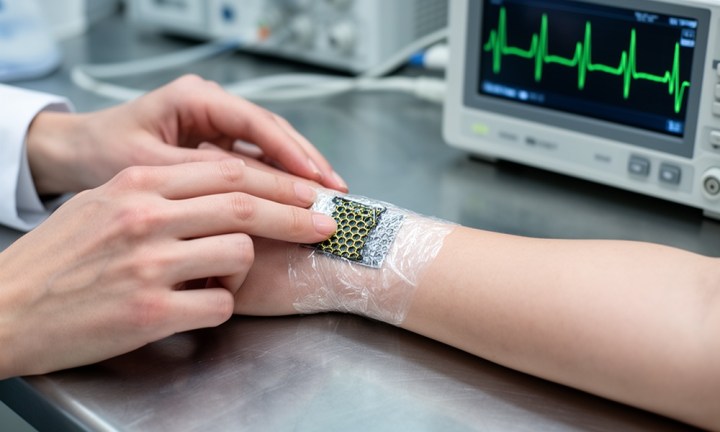
Researchers from Virginia Commonwealth University and Florida International University have developed what they claim is a cold-spray technique that deposits graphene nanoplatelets directly onto a flexible pressure sensor. This can produce a device that adheres to a human wrist and detects a pulse. A peer-reviewed study involved laboratory experiments and testing on one human subject, the results of which demonstrate an early wearable-sensor fabrication advance, though not validated for continuous health monitoring or clinical use.
The researchers created a wearable pressure sensor made from polydimethylsiloxane, or PDMS, a soft, stretchable polymer that molds to a surface. In the process, cold spray applies graphene nanoplatelets directly to the PDMS to provide durable adhesion onto human skin. Unlike conventional adhesion methods that require heating or chemicals and binders, the cold-spray method enables dry adhesion at room temperature.
Reportedly, this approach also avoids tampering with the sensor’s other materials during application. Arvind Agarwal, Ph.D., chair and professor in VCU’s Department of Mechanical and Nuclear Engineering, explains, “The sensor can be made by spraying the sensing material, graphene, directly onto a flexible surface, without glue or several complicated steps.”
The sensor reacted to a press-and-release sequence in 29 milliseconds and continued working after more than 5,000 presses. In testing with a single human participant, it was also able to pick up the person’s pulse. These observations showed strong adhesion, mechanical robustness under repeated pressing, rapid response, and the ability to register a bodily pulse under the tested conditions. The researchers did not establish how the sensor would perform across a wider population, under different movement or environmental conditions, or during prolonged use.
Wearable sensors offer potential benefits for health monitoring, human-machine interaction, and flexible electronics, but their fabrication often relies on costly, multistep processes with limited scalability. The researchers describe their method as a potential route to simpler, scalable manufacturing. For deeper details and data, visit the Virginia Commonwealth University and Florida International University websites.

