

by Mat Dirjish
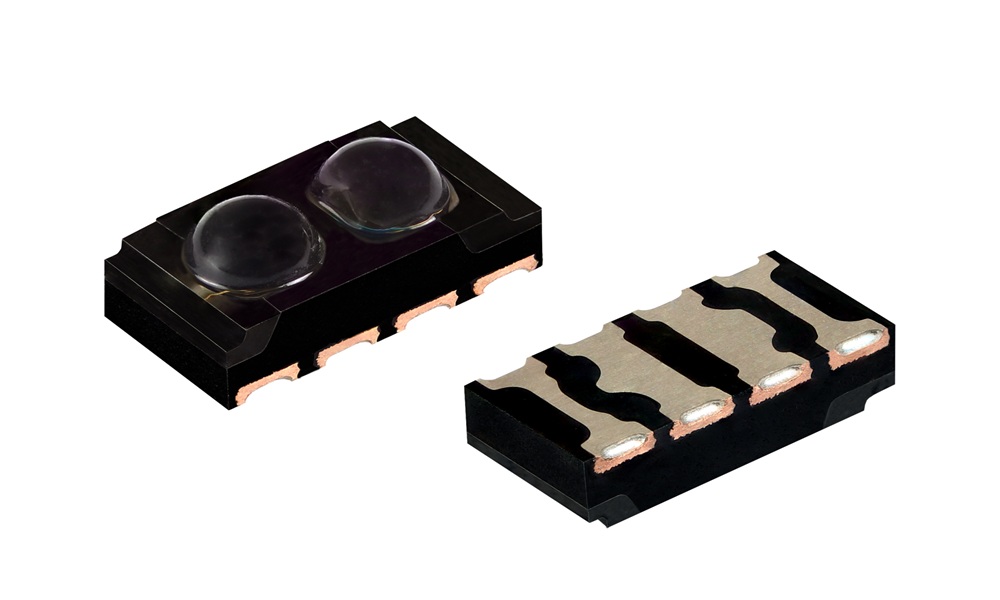
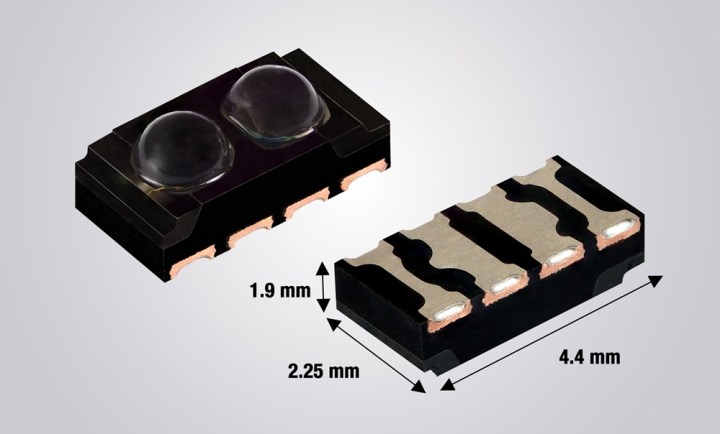
Vishay Intertechnology’s VCND2040X02, VCND2040SLX02, VCND2045X02, and VCND2045SLX02 AEC-Q102 qualified optical sensors promise to deliver fast, flexible, reliable, and wear-free data communications at speeds up to 6 Mbit/s between system nodes. The components combine an infrared (IR) emitter and PIN photodiode in 4.4 mm x 2.25 mm x 1.9 mm surface-mount packages and support decentralized communication between battery cells and system nodes.
In contrast to RF technologies, the sensors reportedly provide an optical communication link that is immune to EMC, EMI, and RFI. Also, the company claims they are more resilient to cyberattacks.
The VCND2040X02 and VCND2040SLX02 feature a single-stack IR emitter and typical rise and fall times of 18 ns, while the VCND2045X02 and VCND2045SLX02 offer a double-stack IR emitter and typical rise and fall times of 9 ns. According to Vishay, the devices’ response times enable high speed performance while supporting simultaneous bi-directional data transfers.
Shared features of the four sensors include two independent lenses and an integrated crosstalk barrier between the IR emitter and detector to minimize optical interference. Additionally, their wettable flank lead frame design allows for their mounting in either side-view or top-view orientations.
Samples and production quantities are available now, with lead times of eight weeks. For deeper details, procure and peruse the VCND2040X02/VCND2040SLX02 and VCND2045X02/VCND2045SLX02 datasheets.

