

by Mat Dirjish
Technology research institute CEA-Leti recently demonstrated ferroelectric RAM (FRAM) scaled to the 22-nm manufacturing node using an innovative 3D capacitor architecture. As per the institute, this breakthrough opens the door to faster, more energy-efficient artificial intelligence (AI) at the edge.
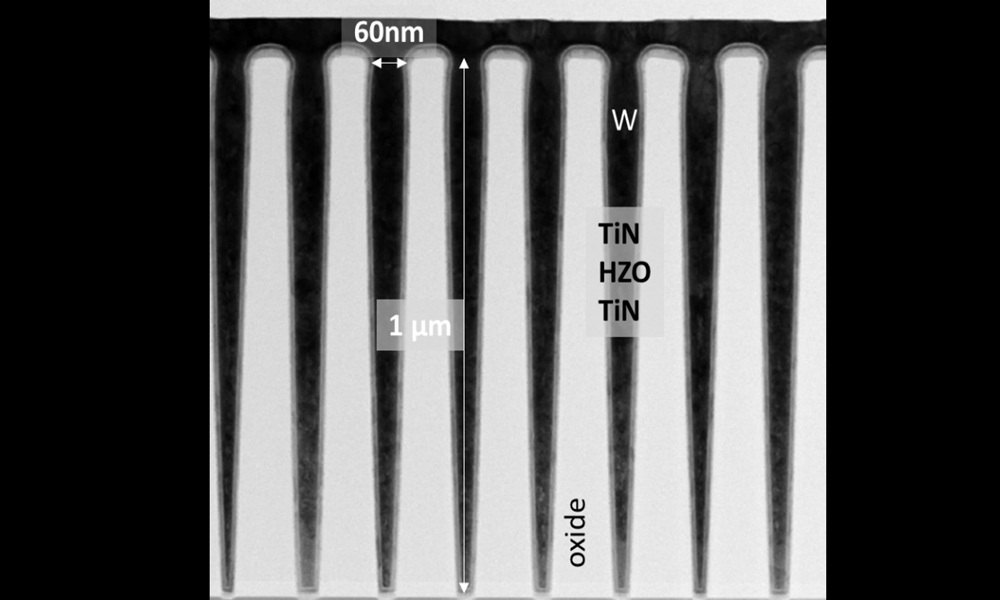
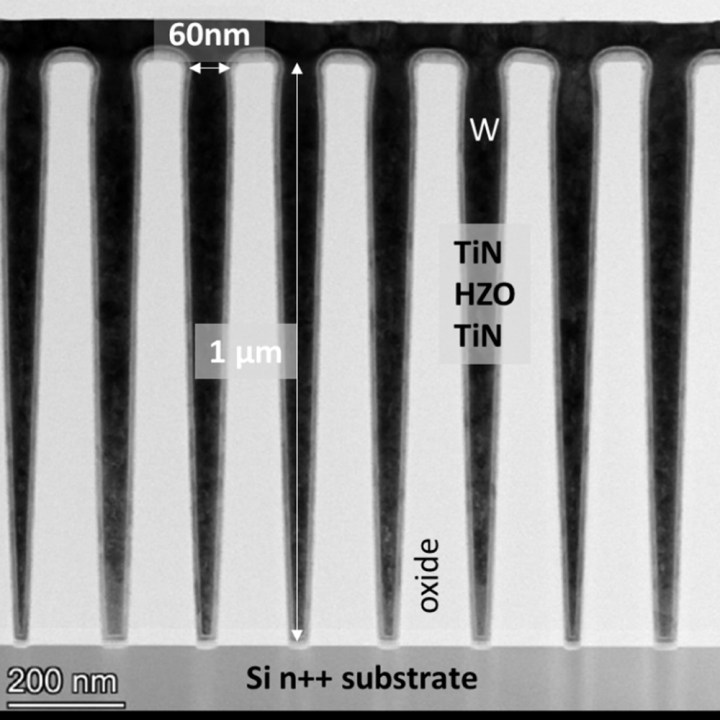
By vertically integrating ferroelectric capacitors made from hafnium zirconium oxide (HZO) thin films, the institute’s memory cells are 2.5-times smaller than standard SRAM at the same 22-nm node. The cells match the density of SRAM at the more advanced 10-nm node. However, unlike SRAM, FRAM retains data without power, thereby combining non-volatility with a density previously attainable only by volatile memory.
Current smart devices rely on sending data to the cloud for AI processing, which is a costly cycle in both time and energy. Fast and dense FRAM embedded directly on a processor enables devices to process data locally. Computing operations account for a significant share of global electricity consumption, much of it generated from fossil fuels. CEA-Leti believes its technology paves the way for highly energy-efficient systems, helping to reduce overall power consumption and reliance on fossil-based energy sources.
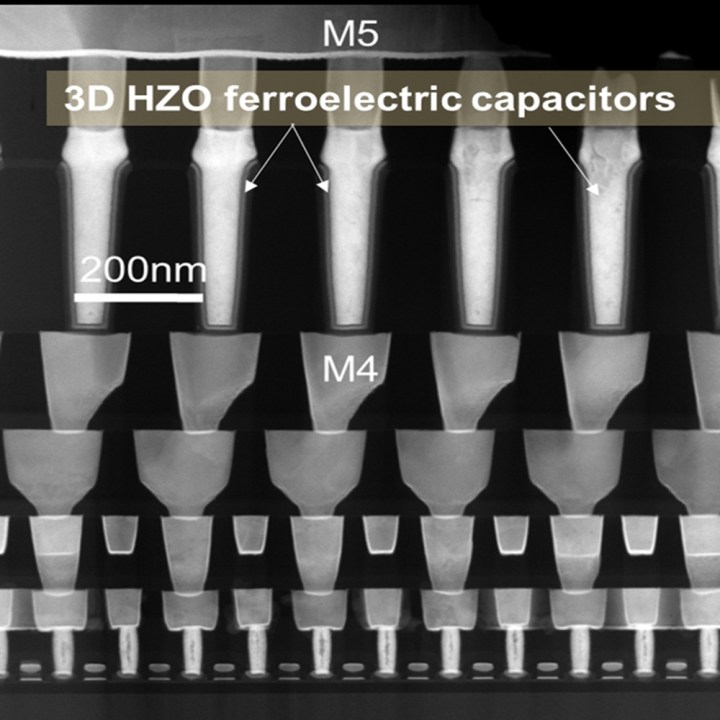
Traditional FRAM devices often exhibit a phenomenon known as wake-up, whereby electrical characteristics shift unpredictably during initial cycling. This degrades stability and reliability. CEA-Leti’s high-aspect-ratio 3D capacitors exhibit wake-up-free behavior consistent with an approximately 80% orthorhombic phase fraction in the HZO film, as confirmed by precession electron diffraction.
While this mechanism is still under study, the suppression of wake-up is likely related to the confinement of materials within the narrow, high-aspect-ratio vias, which modifies the strain state in the ferroelectric thin film. This stabilizes the crystal phase responsible for memory function from the outset. For deeper details and data, visit the CEA-Leti website.
 Mat Dirjish Online